
Founders often view the login page as a simple, introductory feature. You need a box for an email, a box for a password, and a submit button. How hard could that possibly be?
This exact mindset is responsible for one of the most common and expensive missteps in early-stage software development.
At Bee Techy, we audit countless codebases. We frequently see startups draining their runway by paying senior engineers to build authentication from scratch. Building custom authentication is not a badge of honor. It is a massive liability.
Here is a full teardown of why building a custom login system is a $50,000 mistake, and why pivoting to managed authentication is the only logical choice for modern startups.
The Illusion of the “Simple” Login
The core problem with custom authentication is scope creep. What starts as a basic email and password form quickly spirals into a labyrinth of security requirements and edge cases.
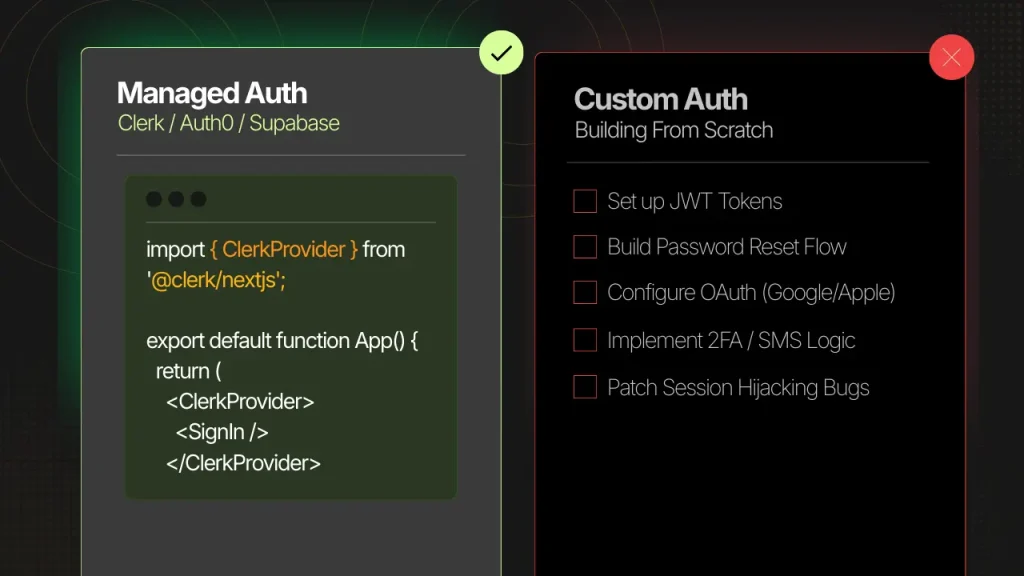
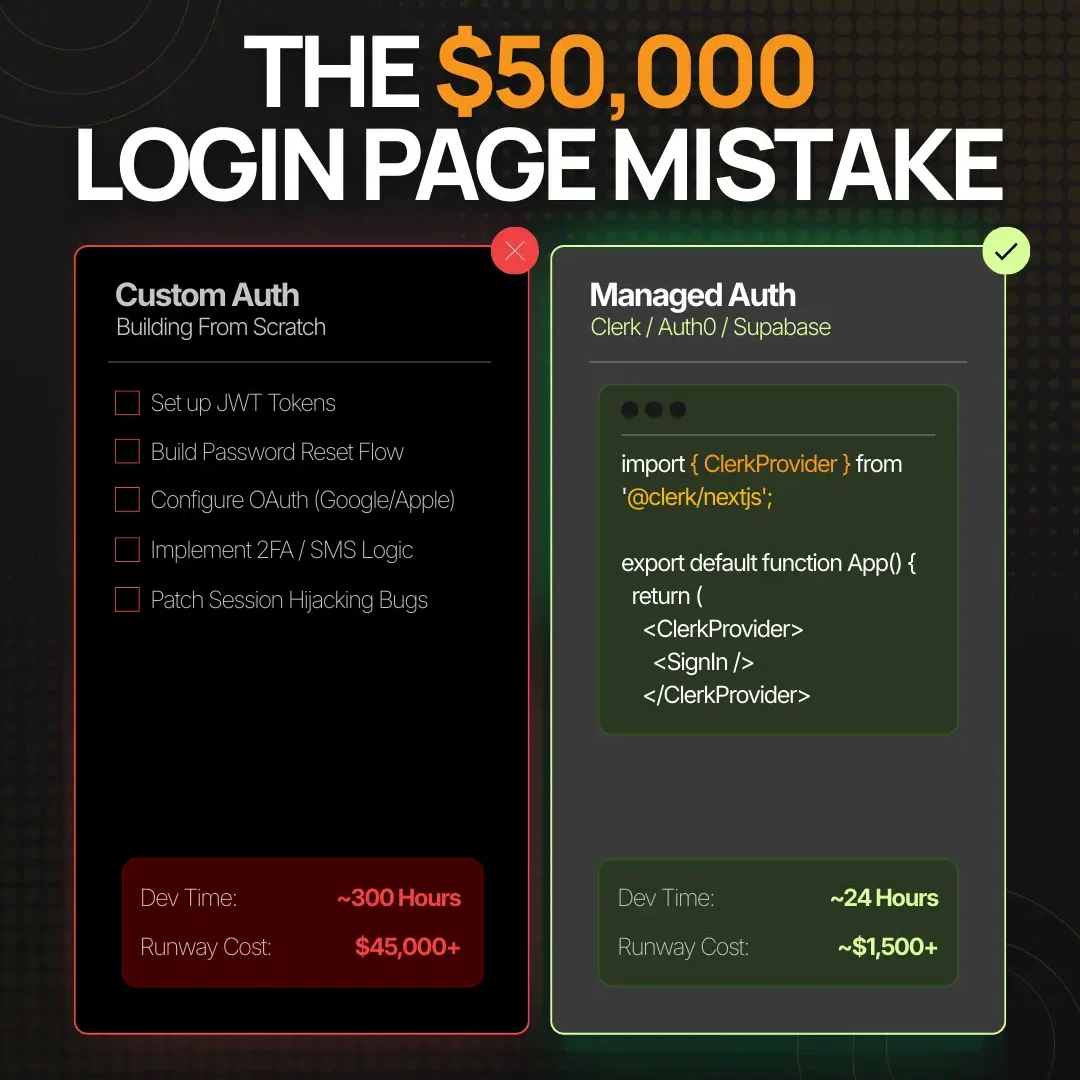
When you choose to build custom authentication from scratch, your engineering team is forced to build, test, and maintain several complex features. This includes setting up secure JWT (JSON Web Tokens), building reliable password reset flows, and configuring OAuth for providers like Google or Apple.
You must also implement Two-Factor Authentication (2FA) and SMS logic, all while constantly patching critical vulnerabilities like session hijacking bugs.
The Real Cost of Custom Auth
These features take serious time to build securely. Based on industry averages and our own internal data, a secure custom auth system requires roughly 300 hours of development time.
When you factor in the hourly rate of a senior full-stack engineer, the financial runway cost exceeds $45,000. This figure does not even account for the ongoing maintenance, server costs, or the inevitable security audits required to keep user data safe.
The Strategic Alternative: Managed Auth
The technology landscape has evolved. You no longer need to build infrastructure that other companies have already perfected.
Managed authentication providers act as specialized third-party services that handle the entire login ecosystem for you. Industry leaders include Clerk, Auth0, and Supabase.
By leveraging these tools, you outsource the risk and the workload. Integrating a platform like Clerk into a Next.js application often requires just a few lines of code, wrapping your application in a pre-built <ClerkProvider> component.
The ROI of Managed Solutions
The return on investment is immediate and undeniable. Implementing managed auth typically takes around 24 hours of development time. This brings your runway cost down to approximately $1,500.
You get enterprise-grade security, seamless social logins, and compliant data handling right out of the box.
Understanding Opportunity Cost
The argument for managed authentication is not just about saving money. It is about understanding opportunity cost.
If your team spends 300 hours building a custom login page, that is 300 hours they are not spending on your core product. Your login page is a commodity. It does not differentiate you from your competitors. Nobody buys a software subscription because they were highly impressed by the password reset flow.
When you partner with a strategic agency for MVP Development, the goal is to validate your business logic as fast as possible. You must ruthlessly prioritize features that generate revenue.
The Final Verdict
Stop paying engineers to reinvent the wheel.
Security is too critical to leave to a hastily built custom script. By choosing managed authentication, you instantly secure your application, save tens of thousands of dollars in engineering time, and free your team to build the features that actually matter to your users.
Treat your runway with respect. Choose managed auth.
Need to Optimize Your Software Architecture?
Stop wasting runway on commodity code. Explore our full library of technical insights to learn how to build scalable, enterprise-grade software efficiently.