
The artificial intelligence hype cycle is officially over. We have entered the era of strict operational execution.
In 2026, enterprise companies are no longer asking if they should adopt AI. They are measuring how deeply they can integrate large language models (LLMs) into their core architecture to reduce overhead and accelerate deployment. Pretending this technology is just a passing trend is a massive blind spot that will cost you your market share.
At Bee Techy, we analyze the backend infrastructure of the world’s fastest-growing companies. Here is your strategic briefing on the state of enterprise AI in 2026.
1. Adoption Rates and Engineering Velocity
The barrier to entry for building robust software has plummeted, but the baseline for speed has skyrocketed.
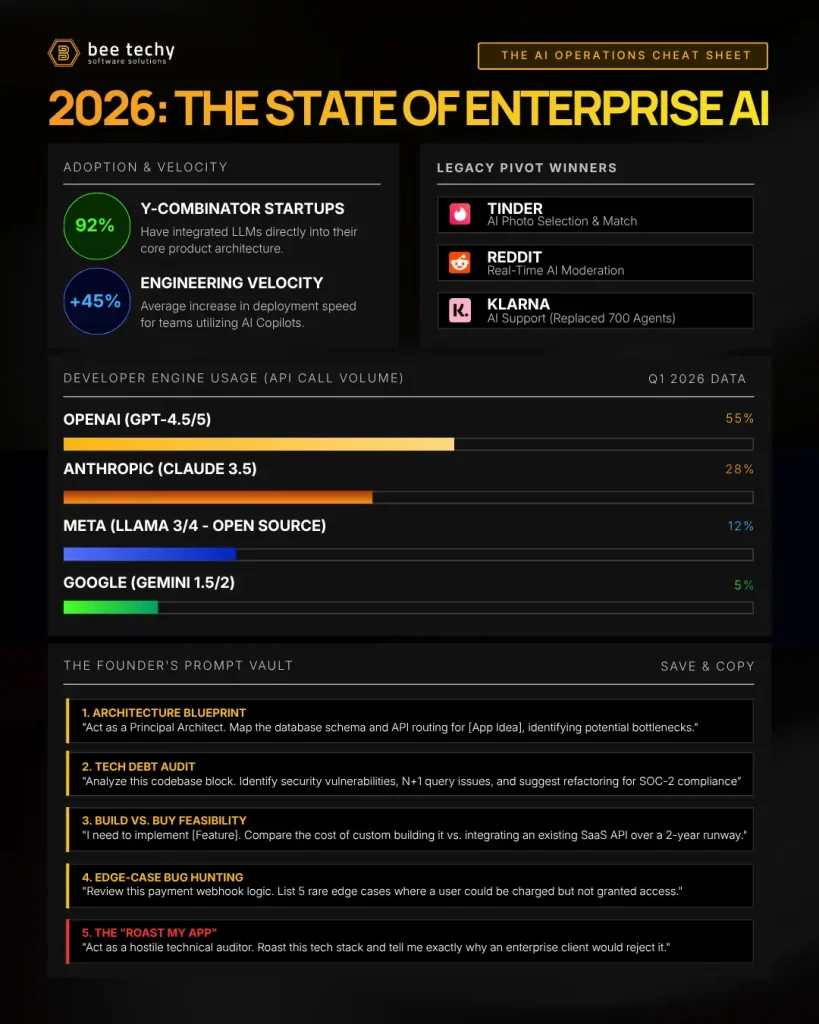
- The Startup Standard: Currently, 92% of Y-Combinator startups have integrated LLMs directly into their core product architecture. This is no longer a competitive advantage. It is the absolute baseline for securing venture capital.
- The Speed Multiplier: Engineering teams utilizing AI Copilots are reporting a 45% average increase in deployment speed. Developers are spending less time writing boilerplate code and more time architecting complex, proprietary value loops.
2. Legacy Pivot Winners
Startups are not the only ones moving fast. Massive legacy brands are successfully pivoting their operations to utilize enterprise AI. They are achieving massive cost reductions and user experience upgrades.
- Tinder: The dating giant integrated AI Photo Selection and Matching logic. By offloading curation to an algorithm, they dramatically increased user engagement and match quality.
- Reddit: Content moderation at scale is notoriously expensive. Reddit successfully implemented real-time AI moderation to handle millions of daily interactions, significantly reducing their reliance on manual human review.
- Klarna: The fintech platform executed one of the most aggressive AI pivots in the industry. By deploying an autonomous AI support engine, Klarna successfully replaced 700 customer service agents while maintaining high resolution rates.
3. Developer Engine Usage: The API Wars
Choosing the right foundational model is a critical architectural decision. Based on Q1 2026 data for API call volume, the market is heavily consolidated.
- OpenAI (GPT-4.5/5): Holding a dominant 55% of the market share, OpenAI remains the default engine for complex reasoning and general-purpose enterprise applications.
- Anthropic (Claude 3.5): Capturing 28% of the volume, Anthropic has become the strategic alternative for companies prioritizing massive context windows, agentic workflows, and nuanced coding capabilities.
- Meta (Llama 3/4): At 12%, Meta is capturing the open-source market. Enterprises that require highly customized, locally hosted models for strict data privacy are heavily relying on Llama.
- Google (Gemini 1.5/2): Currently holding 5% of developer API volume, Google is deeply integrated into specific enterprise ecosystems but trails the primary market leaders in standalone API deployment.
4. The Founder’s Prompt Vault
You do not need to be a machine learning engineer to leverage this technology. You simply need to know how to extract high-value insights. Here are five prompts you can copy and paste today to audit your own startup.
- Architecture Blueprint: “Act as a Principal Architect. Map the database schema and API routing for [App Idea], identifying potential bottlenecks.”
- Tech Debt Audit: “Analyze this codebase block. Identify security vulnerabilities, N+1 query issues, and suggest refactoring for SOC-2 compliance.”
- Build vs. Buy Feasibility: “I need to implement [Feature]. Compare the cost of custom building it vs. integrating an existing SaaS API over a 2-year runway.”
- Edge-Case Bug Hunting: “Review this payment webhook logic. List 5 rare edge cases where a user could be charged but not granted access.”
- The “Roast My App”: “Act as a hostile technical auditor. Roast this tech stack and tell me exactly why an enterprise client would reject it.”
Adapt or Fall Behind
The state of enterprise AI proves one simple fact. Efficiency is the new currency. Whether you are replacing legacy systems or building a new product from scratch, integrating AI is the only way to scale sustainably in 2026.
Ready to Integrate AI into Your Core Architecture?
Stop letting your competitors outpace your development cycle. Explore our full library of technical insights to learn how to build scalable, AI-driven enterprise software efficiently.
Read More on the Bee Techy Blog →